The sonnet sequence, "My Human Disguise," of 630 ekphrastic poems, was begun February 2011. It can be found beginning with the January 20, 2022 post and working backwards. Going forward are 20 poems called "Terzata," beginning on January 27, 2022. Fifty Terzata can be found among the links on the right. A new series of dramatic monologues follows on the blog roll, followed by a series of formal poems, each based on a single word.
Friday, September 6, 2013
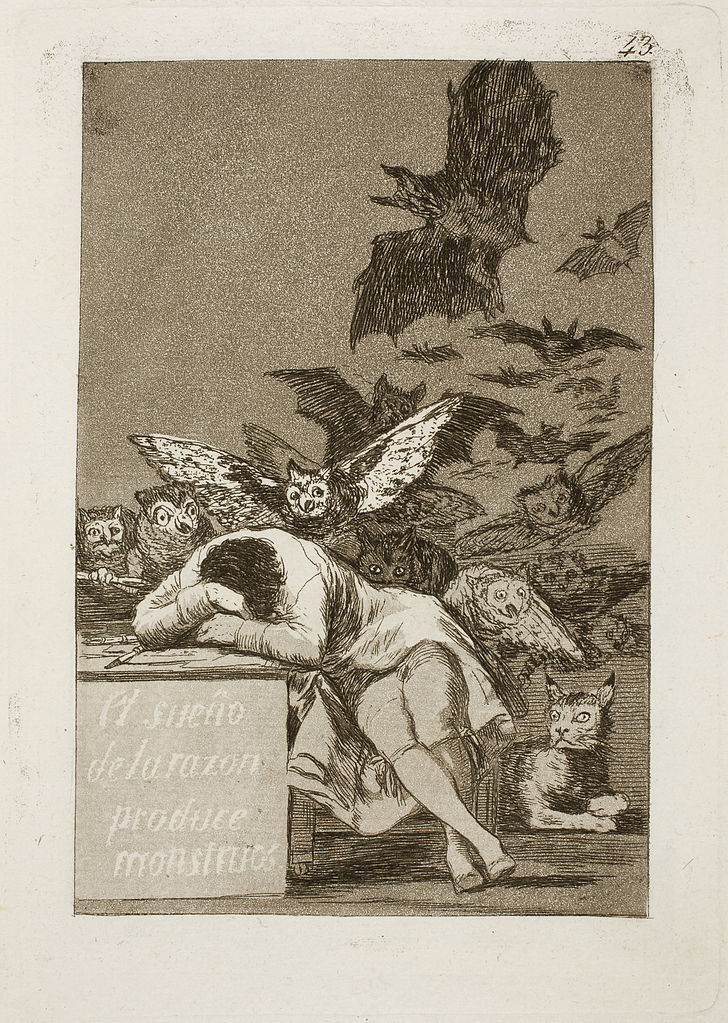
The Sleep of Reason Produces Monsters (Goya)
#135
A compelling thought -- though owls, cats, and bats?
Hardly horrific. So, why should we be afraid?
We dream nonsensical sequences and shifty
Machinations of strangers with their brutal acts,
While mirrors try to remember all that was said,
Before we wake to dull, half-lit reality.
The real monsters are familiars, the mundane beasts
That could turn on us in uncountable numbers,
Always there and ready to amass and devour,
But forbear vengeance as long as we do not cease
To recognize, analyze, judge, and remember.
"Return our stares -- we will always flee and cower,
But abandon yourselves, fail to think and do well,
Our minions will claw out your heart, swallow your will."
Monday, September 2, 2013
The Ghost Kohada Koheiji (Hokusai), Departure of the Ghost (Klee)
#134
Ghosts are the human form of angels and devils.
Depicted as remnants of flesh, or foggy wisps,
They're barred alike from prayers, embrace, and revels.
They're cursed with loneliness and lacerated wrists.
It's said pain lingers, unresolved -- hence their visits.
If devils and angels are the minions of God,
Maybe ghosts are legions we send to the same plain
Of battle, to wander, Cain in the land of Nod,
Between both armies, to prove we've not lived in vain,
If we could but convince them their war is insane.
When they appear before men their message is clear.
Silent and staring, they accuse, or plead, or frown,
And when we try to speak to them, they disappear.
The only ghost I will believe in is my own.
Thursday, August 29, 2013
The Taking of Christ (Caravaggio)
#133
A man who betrays another may have
Many motives, but the sin is the same.
Rationalizing, the sinner will salve
His conscience, oblivious to his shame.
Betrayal is an ambiguous crime,
A "virtuous" act muddied with a kiss.
He says, "Doesn't my judgement demand this,
That I expose this man while there's still time?"
Judas's silver wasn't his motive.
He resented and would never forgive
The burden of his Rabbi's instruction --
Far better to live with His destruction.
A traitor won't betray a lesser knave.
His hanged honor rots in an unmarked grave.
Tuesday, August 20, 2013
The Nightmare (John Henry Fuseli), Sonnet #132
Nightmares are death undergoing animation,
A stiffening fog of imagery shot through
With replete hues and stagey illumination,
Shifting floors and infinitely receding views.
They rarely project what we deeply fear
(Which I won't begin to name even here;
I don't tempt the fates crouching inside me),
Yet made real they would scream insanity.
Nightmares climb over the lip of the ego-well
To give flesh to creatures in my personal hell.
The woman's are not just imps with accusing grins.
Her blinded horse looms with a seeming friendly face.
The humped incubus pins her with her fleshly sins.
That equine smile makes a mocking promise of grace.
Wednesday, August 14, 2013
Carnival In The Mountains (Klee)
#131
The pale, blind lady with the veiny cheeks
Keeps her apples from the reach of the boy
Who's sporting a blue man's grinning death mask.
A fire-breasted chicken watches for geeks,
Extrudes an egg here and there, a decoy.
No head-biter shies from his sanguinary task.
We are in the green mountains where the air
Is green as moss and moss is black as tar.
Clouds droop between the peaks like suckled breasts
And every home is home to nameless beasts.
The Carnival King is a mechanical man,
With lightning brains and an eye for a hand.
The revelers kill him with a handful of sand,
And dump the apples into his belly trash can.
Monday, August 5, 2013
The Cicada Killer and The Cicada (photo by Bill Buchanan, silver sculpture by Ruth Diamond-Guerin, drawing by Julia Guerin)
#130
We saw the hill of sand by the sidewalk,
The first time in the 30 years we've owned
This house. In twenty minutes the killer
Landed twice, clutching a cicada, dragged the bulk
Underground. Her wings made a rasping sound.
I drowned her with a gallon of white vinegar.
I feel some guilt at the sand wasp's demise,
But love of purity allows no compromise.
The cicada's song is the sound of all yearning.
His hollow abdomen and drumhead tymbals
Expand and contract, reverberating like symbols
Whose meaning demands a lifetime of learning.
Listen. The song, breathless, aching, intensifies,
Irradiates, irradiates the air -- and then it dies.
With this, the 130th sonnet in the "Brushwork" sequence,
I'd like to recognize my best friend and editor, Michael Antman,
who has read, closely, and critiqued every single sonnet. I
appreciate his time, honesty, clear insights, and excellent advice,
which I've invariably taken.
Tuesday, July 30, 2013
Metamorphosis III (Escher)
#129
Birds, insects, and lizards live in cages
Whose bars and locks melt over the ages.
Their forms meld in imperceptible stages.
Their names disappear from taxonomic pages.
We know that nothing without time changes,
That duration inexorably deranges
Our genes, ideas, stars, and mountain ranges,
That metamorphoses aren't equal exchanges.
And then there's growing old, which nothing assuages.
We spend a life making babies and wages,
Then nothings such as mirrors enrage us,
And no comfort comes from priests or sages,
But this: not all is rust. Yes, everything ages,
A puissance that releases us from our cages.
Subscribe to:
Posts (Atom)
