Showing posts with label ekphrastic poems. Show all posts

Thursday, March 14, 2019

Contrast (Order and Chaos) (M.C. Escher), Sonnet # 448

My book of the first 200 of these sonnets is now available for purchase. Click here:
My Human Disguise.


Which of these is the impossible object?
I think the bottle, pipe and flowerpot
Are too much victims of serene neglect.
The string isn’t tied with a proper knot.
The opened can and the crumpled up box
Are both containers that don’t come with locks.
Nothing is whole in itself — the heel plate,
The cork, or the sardines someone just ate.
Even the tool (I don’t know what it’s for)
Needs some receptive substances to score.
You think I’m ignoring the obvious,
A crystal globe that’s pierced with pyramids,
An object of reflections marring grids.
The only impossible things are us.

Thursday, July 20, 2017

Ship of Fools (Bosch), Sonnet #360


The ships of fools — hardly a pram —
A million in a small puddle
Full of people squealing, “I am!” —
A multitudinous muddle —
Even the largest has no rudder.
Beneath the overcrowded weight
The untarred bow plankings shudder —
When they burst there be men for bait.
Till then the riotous party,
Victorious, brave and hearty,
Gorges and drinks to their winning
Saint they love most when he’s sinning.
A busted lute leads them in song:
“Dam’ned they be, both right and wrong!”

Note: Click on the image to see a larger
version.

Thursday, December 8, 2016

The Narmer Palette (3,000 B.C.), Sonnet #327


It's said Pharaoh spoke in twittering rhyme
Due to his lacking a crucial enzyme,
Because he ate off of a golden plate
What he'd repeatedly regurgitate.
His crown was golden too, a heavy weight
He wore a rug beneath to soothe his pate.
He smote his enemies with a scepter,
A wand of lead he called his "preemptor."
He had a single rigid policy:
"I'll destroy you before you can hurt me."
That was more than five thousand years ago.
This palette is all that's left of Pharaoh.
They say he ruled a united Egypt,
Leaving nothing not ravaged, empty, or stripped.

Thursday, November 10, 2016

The Seventh Plague: Hail and Fire (John Martin), Sonnet #323


It froze us in small blocks of ice
And rolled us down the streets like dice.
It melted us with filthy light
And left us purified of blight,
Exhausted, blameless and alone,
The roaches and pigeons gone.
We never saw a cloud again.
Instead appeared new kinds of men.
They smiled but we ran from them,
From their split tongues and spit venom.
They gladly swallowed the locusts
When they came, as well as our lusts.
The darkness never descended.
The promised end never ended.

Thursday, November 3, 2016

Avenue of Poplars in Autumn (Van Gogh), Sonnet #322


The faintest chitter of leaves in the Fall,
The slant auroras beneath the branches,
The blue-gray clouds that are not clouds at all,
But cloudless sky the fading light blanches,
The warmth and the chill I feel on my cheeks
As sunned and unsunned breezes alternate,
Each gust not finding what the other seeks,
And not one beast seeking to find a mate.
Today I walk this ordered avenue
Until the moon tops the furthest poplar.
It's so bright I can't see a single star,
A Milky Way I cannot know, but knew.
I reach home as the shadows slip away.
Only the moon's been moved enough to stay.


Thursday, October 6, 2016

Gare Montparnasse, The Melancholy of Departure (Giorgio de Chirico), Sonnet #318


The second hand always departs.
The minute hand always arrives.
The hour hand claps at our lives
With one hand that stops and starts.
We climb the red stone clock tower,
Stare out slits in its white faces.
Its hands are minute and hour,
No second, which just erases,
Like the one on my mantelpiece,
Always threatening my decease.
We need a hand for time to come,
One that whirls while always slowing,
That tells us (since the hour's dumb),
When we'll be without our knowing.

Thursday, July 14, 2016

LOFT (Michael Antman), Sonnet #306


The loft will fall if the foundations rot.
The window frames are already bending.
The masonry, pitted by ageless soot,
Awaits the inevitable rending
Of every pillar and joist underneath --
The spitting of mortar like broken teeth.
Two pairs of women's shorts are on display,
But the lonely workman ignores the show.
Naked legs would only be in his way.
He turns the electric vacuum to blow.
Now he must wait for everything to dry.
He looks up for the first time, starts to cry.
He's sundered by a sweet paralysis.
It's beautiful, he thinks, not sure what is.

This is the third photo by my friend and editor
Michael Antman that I've written about. You can find his
considerable collection of photos at Instagram,
at https://www.instagram.com/michaelantman/
Or, if you're already on Instagram, his username
is michaelantman.


Thursday, April 14, 2016

River Bend (photographer unknown), Sonnet #293


I've had this image in my head for years.
Not exactly this place or century,
Or the season (no, that was never clear;
Late summer, early fall, most probably):
The hills smoother, the water cascading
From sand pools to shelves of smooth black granite,
Huge trout leaping at the sunlight's fading,
In time with the spinning of the planet.
I stand on the edge of the sandy spit,
Landing big brown, my Coachman in his jaw.
For one moment a cold and useless law
Flashes in his eye and dims his spirit.
I never know what happens in the end,
And won't until I find that river bend.

Thursday, January 21, 2016

Orion in Winter (Charles Burchfield), Sonnet #281


Tonight the stars sleep with their eyes open --
The only way they can see each other.
Orion hunts with eternal hoping
As he was taught by his Gorgon mother.
The stag was belly-shot miles back and stares,
The constellation swirling in his eyes.
No one stepped out beneath the winter skies
To follow his blood beneath its bright flares
To end his agony with guns. He dies,
Ascends to run with lions, wolves, and bears.
Furious Orion ropes nearby stars
And lashes up his celestial car.
He'll drive it hard to the home of his birth
And hunt to death every man on earth.

Note: In Greek mythologyOrion was a gigantic, supernaturally
strong hunter, born to Euryale, a Gorgonand Poseidon (Neptune).
It is said he once boasted that he would kill every animal in the
world.

Monday, October 19, 2015

Animals Extreme (Alice Guerin and Julia Guerin), Sonnet #266


Animals extreme are everywhere:
A laughing camel, sober wildebeest,
And four horses of the Apocaleast,
Dancing with a tang of Devil-may-care.
In my back yard the chipmunks chuck, chuck, chuck,
A sound like the jake braking of a truck.
The hummingbirds have taken to swilling
Berry wine. Our cats yowl like Bob Dylan.
The horses cavort until they are one,
A heady beast just dying to have fun.
The wildebeest needs to cheer up a bit.
It's not the end of the world, friend, not yet!
And you, my humpy friend, laugh all you want,
As you'd want me to, like Emmanuel Kant.


Note: Horses by Alice Bea Guerin and Laughing Camel
by Julia Rose Guerin. Click on the image to see a larger
version.

Wednesday, October 14, 2015

Vimalakirti, (Painter Unknown), Sonnet #265


Even a Buddha would think that the dark is light
And all is nothing and nothing is
is bullshit.
Thunderous silence is any mind's steady state.
On every eyelash thrives a ravenous mite,
Vimalakirti would have said, had he the wit.
We cannot eat what those who came before us ate.
There's one answer to each question, which is silence.
What is red? Why is Cassiopeia that way?
What is the difference between past and future tense?
What did you say? What do you say? What will you say?
On a clear day, the horizon line on the lake
Is the turned-away cheek of a sleeping Baku,
Devourer of nightmares. He is me and you.
Hold your tongue, close your eyes, and stay awake.

Thursday, August 27, 2015

Eagle (Kishi Ganku), Sonnet #258


The feathers only frame the human eye,
A master's eye, an enlightened being
Who sees the flea struggling in the sand,
Who has forgotten to forget the I,
Who sees the present in all that's fleeting,
Who wields a heavy and powerless wand.
I suspect enlightenment, when men "see,"
Is nothing much, a mere epiphany,
A moment of insight, most certainly,
But not quite a glimpse of eternity.
A piercing human eye, an eagle's soul?
The teachings of Jesus, Buddha, et al,
All come down to this. You're free. It's your call.
Do good, love all men, don't be an asshole.

Saturday, August 15, 2015

Moebius Strip With Ants (Escher), Sonnet #255


Now is now, but then isn't then.
It was then, then it looms again,
Then. A conundrum, very Zen.
Ants follow only the given
Road, arriving where they begin,
Unaware of the moment when
What seemed a simple and open
Path becomes blind beyond reason.
The page is the time of all men,
Where the word released by the pen
Can grace the past with an amen,
Or trace loops of evil omen.
It's the same word, this very "then!" --
Old oxen and a lighting wren.

Wednesday, July 15, 2015

Multi-Dimensional Snake (Alice Guerin), Sonnet #251


The snake ends in a thinning tail
Of muscle, tiny bone, and scale,
A diminution of its head.
Like the forking of its tongue,
Its tails distend to seek, to flick
The next-dimensional-instead.
Can it hear the hissing songs sung,
Like fire from two extra wicks?
He tolerates the division
Until the fangs of other snakes,
Coiling beyond his vision,
Bite him once, again. He awakes,
Lunges, bites his own tail, angry,
Only to find not one, but three.

Thursday, July 2, 2015

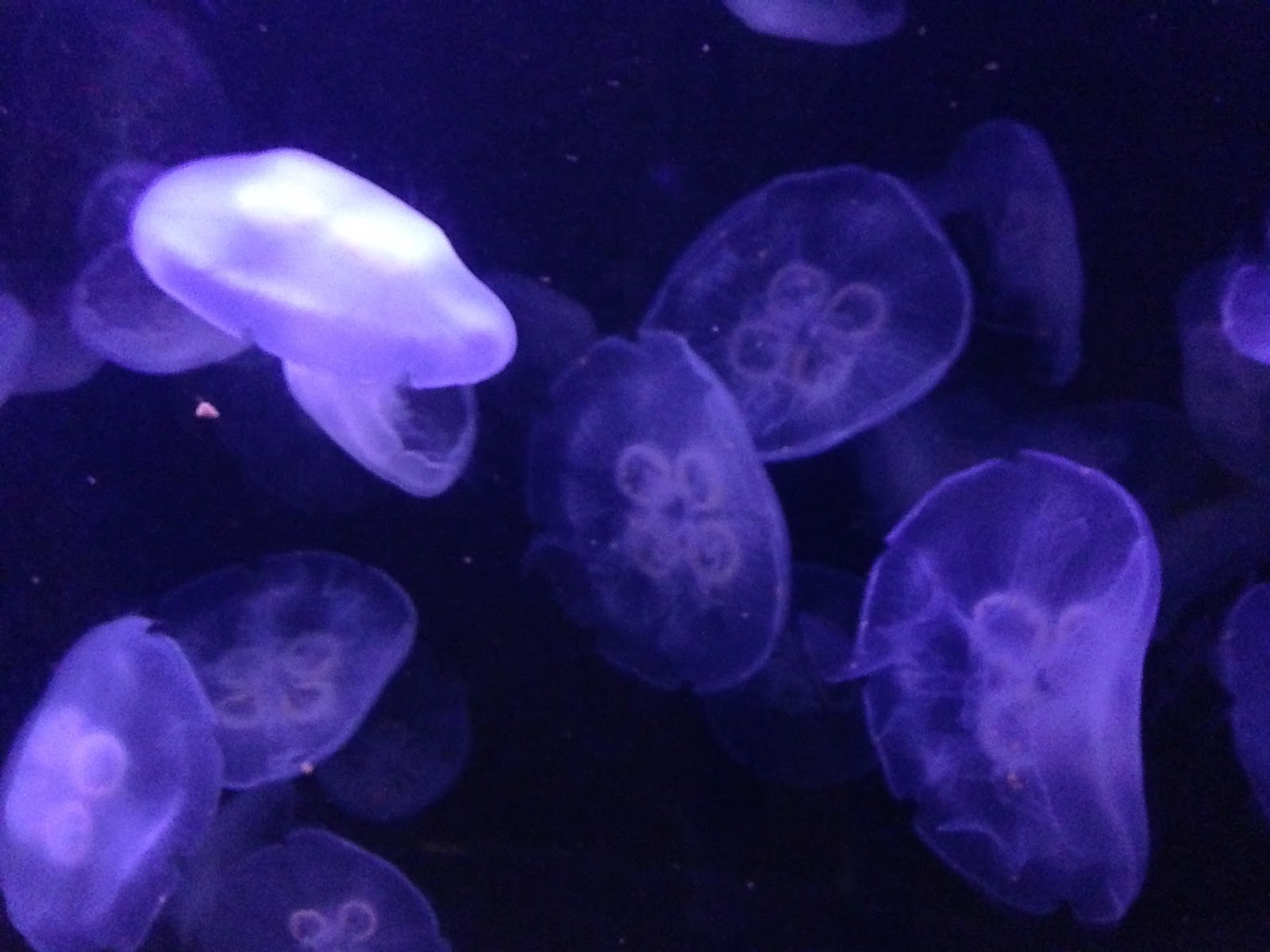
Moon Jelly, Sonnet #249


The moons of Earth and Jupiter
Move in space pierced by meteor,
Comet, radiation, asteroid.
All dead things exist in a void
Full of other dead things that fly
Day by day at infinity.
One cannot love the moon jelly.
They're as empty as the word "why."
Instead, we fill them with ideas,
Those bits of us we understand,
That drift along in conscious seas,
Never once in sight of land.
They vanish and then reappear,
Vestiges of another sphere.

Friday, May 29, 2015

Bodhidharma (Hakuin), Sonnet #244

For Lucien Stryk

His eyes tell us he grasps nothing he sees.
Nothing like shock, wonder, or puzzlement
(His purpose, to see only by degrees),
His response is a dog's to a new scent.
The more he's enlightened, the more dour,
Saddened by the presumption of a flower,
Disillusioned by the barred owl's power --
Endless patience where the field mice cower.
As he stared into a cave for nine years,
Did he presume to think he saw it all,
What is, what isn't, on a granite wall,
That makes a mockery of monks and seers?
Here he's a presence more paper than ink,
All marrow, nothing more, no sense, no think.

Lucien Stryk was one of my writing teachers
at Northern Illinois University. A fine teacher
and poet, he was very influential in
bringing Zen poetry to the United States 
through his translations and interviews. He
was a good friend and mentor.

Wednesday, April 29, 2015

With The Eagle (Klee), Sonnet #241


He can be only the smallest part of our lives.
Over the years I've watched him not even a day.
In spring, circling a pond near leafless woods, he dives
And, skimming the water, dips his talons -- his prey,
A small bass. He lands on a dead tree and devours
All in seconds. Motionless, he'll rest there for hours.
When the trees leaf out he is much harder to see.
A nest, big as a pram, disappears, and his mate,
Whom he uxoriously trades nesting duty,
Will fly off to hunt for herself what he just ate.
The eagle sees me more clearly than I see him.
He doesn't care for me, so I remain a dim
Apparition he never completely ignores,
From caution, a mystery he never explores.

Saturday, April 25, 2015

I Have, I Had (Matta), Sonnet #240


When they gut old buildings, first they divide
Them into mountains of aluminum
And copper, structural steel and gypsum --
Then the ponderous wrecking ball collides.

One birthday, I received a lead army,
Painted soldiers, heavy, but pliable.
I broke the head off of one and, to my
Surprise, they all broke. Who was liable?

We wasters of yesterdays! Of sorrows
Our dying memory dimly borrows!
The meteorite I held in my hand,
The man who pointed a gun at my head,
As of today have been thoroughly banned
From being, soon being nothing I've said.

Thursday, April 23, 2015

The Two Goats (Gustave Dore), Sonnet #239


In Memory of Jim McNiece

A cataract has cloven the mountain
For centuries -- unnumbered leaves and stones,
Ripped tree limbs, clots of mud, and broken bones,
Fall for miles in the deafening fountain.
A sycamore tree topples in a burst
Of lightning, and forms a treacherous bridge
From a mossy patch to a granite ridge.
Two old goats cross (neither arriving first)
And butt heads at the middle of the tree,
Gently, a nudge, a token of greeting,
Of grudging respect, then a wild bleating
Of hatred and threat. There'll be no treaty.
Only one backs up for a running start.
The other charges, blasts his hornlike heart.

Jim McNiece was my writing teacher and dear
friend at Northern Illinois University. He was
a merciless editor, expunging the lazy, prolix,
or innaccurate word or phrase. I thought of him
as I rewrote this poem many times. We also
butted heads more than once.

Thursday, April 16, 2015

Spring (Jean-François Millet), Sonnet #238


The winters harden these years, and the snow,
Feet of it even in March, melting slow
In tepid, foggy air, washes our dregs
Into the broken river. The aging
Magnolia in the yard, stung by frost,
Still blossoms, only a few petals lost.
Now begins the long-deferred uncaging
Of sun and sex and bud and leaf and eggs.
My Ruthie and I walk the park most days
And notice, after thirty years, it says
What it always has, that it's merely ours
To wander and watch and never to touch.
Inside a log a young kit fox cowers;
Above, the barred owl's talons shift and clutch.