Thursday, August 24, 2017

Three Spheres II (Escher), Sonnet #366


The past is images faded into patterns,
A dim, smudged diary of pleasures and concerns
We see through a crystal sphere of water and oil,
A second universe of calm and bitter moil.
The future yet to appear is already here,
Like the moon in clouds or a mask, a faceless sphere.
We can’t be sure, but we’re almost convinced it’s there,
As we take on faith there’ll be a next breath of air.
The present is our own distorted reflection
To be, added to the past’s fading collection
At the instant we see the next experience
With a curious and innocent prurience.
No; present is our eyes, myriad blinking spheres
That see through reflections to find that we are seers.  

Monday, August 21, 2017

The Cricket Eclipse, Sonnet #365


He chirps beneath our crabapple tree all night long.
The cricket’s krrrr is a two, three and four beat song,
Random and loud. He stops when a voice from afar
Seems to answer, rasping the same note bar for bar.
(The cicada’s bright buzzing in the August sun
Is lovelier, but isn’t meant for anyone.)
I do not understand the cricket’s existence,
His urgency, or his athletic persistence.
He fills the humid summer night with his griping,
Yet stops at the first pre-dawn robin’s sweet piping.
I’ve never heard him make a sound during the day,
Until today, when the air went from light to gray.
As the sun’s eclipse spread its mockery of doom,
I heard all the crickets in the neighborhood boom.

Thursday, August 17, 2017

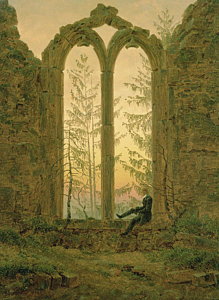
Ruins Of The Oybin Monastery (Caspar David Friedrich), Sonnet #364


The monastery, a home of belief —
It doesn’t matter which — slowly decays.
The roof beams go first, nothing wooden stays.
Moss paints the stone arches in bas-relief, 
Images of dead and forgotten grief.
We live in roofless rooms with a sly thief,
Who steals, first our parents and eldest friends,
Then our useless youth, which he quickly spends.
Our music and books are replaced with fakes,
Our mirrors with odd faces, double takes.
Though I could not kill the thief if I would,
I defy him — plant flowers, kiss the wind.
I have children I hug; I’ve seldom sinned.
He can’t have my memories, bad or good.

Thursday, August 10, 2017

Lake Michigan Lightning (Julia Guerin), Sonnet #363


The mantle of the lake, the shield of the sky
Holding back the stars, and, on cloudless nights,
The sunset, button the lake and sky closed.
The first barely audible thunder sigh
Is preceded by a cloud-blurry light.
The sound grows orderly, almost composed.
It’s midnight and I stand at the window.
The lightning never flashes where I look
And blinds me from above and below,
The lake refracting every crooked hook.
When it’s upon me, I cover my ears
And close my eyes to resurrect old fears.
Then the rain comes and the violence flies
Up the hills behind me and quickly dies.

Thursday, August 3, 2017

The Death of Sophonisba (Pierre Guerin), Sonnet # 362


I don’t know if my intentions for this painting
Will be interpreted by my descendant who
Will write about my treatment of a suicide.
I hid her beauty in a semblance of fainting,
Head rested on crossed arms, slumped, seated, eyes blue,
A victim of her new husband’s weakness and pride.
I hope he’ll see into what I’ve tried to convey,
Not the tragedy, or the waste, but the decay
Of sense and feeling in a woman betrayed
By politics and a perversion of honor.
Yes, a woman used like a beast, a perfect maid
Who died still with the worst sin dishonoring her.
My heir, absolve both her and me of betrayal
In the sympathetic lies in my portrayal.

Note: Sophonisba drank poison in 203 B.C. to save her 

Carthaginian husband’s life and honor. Pierre Guerin, 
the painter, is speaking of me, his “descendant,” though 
it is unlikely that I am one.

Thursday, July 27, 2017

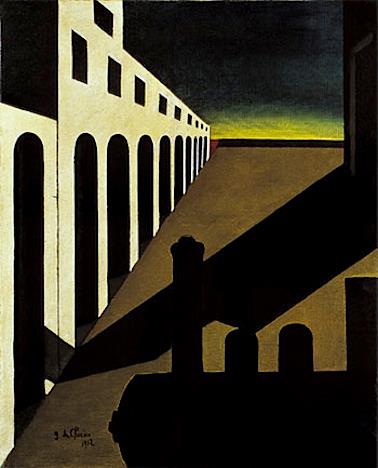
The Anguished Morning (de Chirico), Sonnet #361


Morning light steals darkness from its hiding places.
The unadorned plastered wall or triumphal arch
Outlines the visible by what it erases.
With each second the shadows go colder and parch.
After dawn the dark runs flat and dense from the square
Over vast lawns up the side of the cathedral.
A locomotive engine with its human bawl
Stops silently for a few hours, won’t be where
Decades ago before the wars the tracks were laid —
It wanders up the plaza like a drunken shade.
We don’t venture then into the shadows or sun.
A fool would let himself be caught by either one.
Morning light steals our souls from their hiding places,
Defining what we are by what it erases.

Thursday, July 20, 2017

Ship of Fools (Bosch), Sonnet #360


The ships of fools — hardly a pram —
A million in a small puddle
Full of people squealing, “I am!” —
A multitudinous muddle —
Even the largest has no rudder.
Beneath the overcrowded weight
The untarred bow plankings shudder —
When they burst there be men for bait.
Till then the riotous party,
Victorious, brave and hearty,
Gorges and drinks to their winning
Saint they love most when he’s sinning.
A busted lute leads them in song:
“Dam’ned they be, both right and wrong!”

Note: Click on the image to see a larger
version.