Thursday, February 20, 2014

"It's Tradition, That Makes It Ok" (Taylor Carpenter), Sonnet #165

"Nothing is too normal," the Add Man likes to say,
As each day he brings a new thing into this world.
His pockets are filled with walnuts with ideas curled
Inside. "It's time!" he postulates, "to crack away!"

The butt of his ax frees ten trillion telephones
And a machine for turning metal into bones.
For fun he introduces a nasty pop star
And rewrites the extinction of the dinosaur.
He throws us all a scare with a meteorite,
Then he warms the globe, or doesn't -- though he still might.

His porker has been with him since its ear was tagged
With instructions to eat the empty walnut shells.
He's chomped on them for ages and only once gagged.
Our hero often says, "There's Hell, but we like hells."

Friday, February 14, 2014

A Murmuration of Starlings (Sonnets #163 and #164)


#164

Sixty thousand draw arabesques in formation.
Are they not hive-minded (doesn't each one
Each day turn the murmuration its way
Just once?), and a miracle of concentration?

They gather in the late autumn afternoon sun,
Purpose hidden behind each cascading array.
It's said their wings never come closer than seven
Inches, even with the most abrupt turn or dive,
Or clustering darkness that their rising leavens.

Perhaps they simply close their eyes and trust
To surrounding air sounds to stay alive.
With every change in direction they thrust
Forward, or drop, or turn, or rise, or stall --
Not one will falter, wing awry, or fall.


#163

Some scientists hypothesize
That a starling murmuration
Aggregates them to synchronize
And make one mind from a nation.

Like oscillating overtones
Of a guitar string's harmonic,
Each bird emits a low sonic
Signal to each bird's hollow bones.

Or, perhaps, their wings carve the air
Into symbols they all can read,
Like instructions, that tell them where
They'll soon find berry, grub, or seed.

Or do they so adorn the sky,
Just to do it, no reason why?

--------

Here's a video of a stunning example of a murmuration of starlings.

Wednesday, February 5, 2014

Elemental (Sonnets #161 and #162)


#162

There's an idea (fake as this pyrite ball is gold),
That these shapes possess some elemental structure --
"A pyramid breaks into triangles and square."
My New Math teacher once, patiently, told
Us a plane held infinite points. I wasn't so sure.
I asked, if I take a sharp pencil to paper
And make a million dots the paper won't turn black?
It's a concept, he answered angrily, not fact!
Cube, sphere, prism, octahedron, and elliptic
Palm stone -- some machine cut, some grown, some nature-made --
Arranged on my highboy, formulate a cryptic
Code of concepts curiosity can't evade,
Though we examine them without penetration.
Their rigid simplicity mocks contemplation.


#161

Simple. Elemental. Basic. Fast. Essential.
Are these the bricks and mortar of the universe
Or the toys and pastimes of a collective mind?
It's true, some find them holy and reverential,
Expressions infinitely eloquent, yet terse,
Or like paintings, not quite finished, though signed.
Do lines along two axes meet only to end
Or pass on into a negative world designed
To balance everything, or do all lines there bend
And nothing here is ever perfectly aligned?
The mind, like gravity, tends to make things rounded.
Ideas are circuitous; words circle, spiral.
Convictions are light trapped in a mirror-lined ball,
But no line stops a line; no thought is unbounded.

Thursday, January 30, 2014

Love at the Fountain of Life (Giovanni Segantini), Sonnet #160


Beside the fountain a stunted, misshapen tree
Is about to take the lovers' testimony,
One secret word the woman will laughingly carve
Deep into its flaking and lichen-mottled bark.
This is long before the ages when men will starve
In deserts, murder prophets, need to build an ark.
An angel dutifully guards the fountain; bored,
Lonely, she hardly notices lovers approach.
She remains unseen until the word is scored,
A blasphemy deserving the sternest reproach,
Which, alas, it's not given her to deliver.
Her wings shield her own eyes from their eternal shame.
"Drink here," she says, "from this fountain, this life-giver."
With a sip each lover forgets the other's name.

Friday, January 24, 2014

OUR NATURE (Sonnets #158 and #159)


#159

Barred Owl (Audubon)

Late last night, the owl settled on our shepherd's hook
Outside my bedroom window. A feeder hangs there --
Mice and chipmunks burrow below and filch the seed.
I watched him for an hour. His head bent down to look
For prey, three times he lifted his pale face to stare
At me, but I was nothing compared to his need.
His head pivoted three hundred sixty degrees,
Slowly surveying the snow-covered yard and trees.
Otherwise, he was still; his art was vigilance,
Like a sailor in a crow's nest looking for land.
Then he crouched and bobbed and dropped, his patience
Goaded. A moment later his great wings fanned
And lifted him to a limb where he ripped apart
A mouse and devoured its still trembling heart.


#158

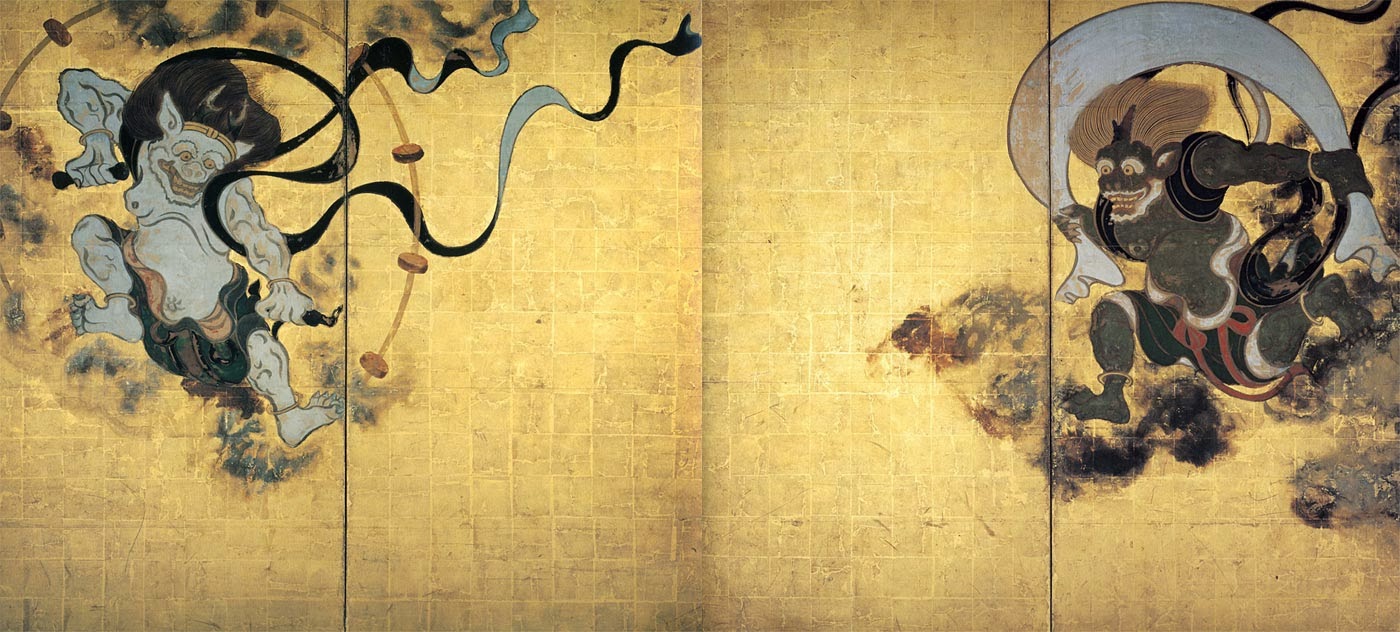
Wind God and Thunder God (Tawaraya Sotatsu)

As children we feared the thunder,
Though the wind willed us to wonder.
We were such small receptacles,
Anything that caused emotions
To overflow were spectacles,
Like typhoon-tormented oceans.
A clap of thunder convinced me
Our house would collapse instantly,
But I could lean into strong gales
And laugh, arms outstretched like taut sails.
The gods don't always indulge us,
Like these fiercely smiling fellows.
They are about their own business --
The boom of death and hell's bellows.

Thursday, January 9, 2014

The Fall of the Rebel Angels (Bruegel), Sonnet #157


There's no reprieve. The angel falls out of its soul,
Becomes a creature of the earth, a splitting toad,
Blowfish, shark, naked soldier, or blind vole.
From eggs grow butterfly wings and white tails,
Reptilian, self-constricting. Calm angels goad
And herd them with blackened swords, spears, and flails,
Their wings edged with dried blood. A pustulant strumpet
Dances to the wailing of a thousand trumpets.
This is the great war of faith, so nothing must die.
One angel, still robed, tries, but can no longer fly.
Nearly blinded by the sun, it can't choose between
What it once believed in and what its eyes have seen,
And, crashing, becomes Belial, verminous beast.
His diseased tormenting of man has never ceased.

Thursday, January 2, 2014

Trees in the Snow (Caspar David Friedrich)


#156

We cut down dead oaks to reopen the old mine,
One hundred years abandoned, a collapsed shaft,
And no promise the old diggers hadn't been good
At their work and found every nugget worth a dime.
My partner wasn't afraid of the dark and laughed
When I said, you go first beneath the earthen hood.
That was twenty years ago and old Caspar died
Before a single shovel was turned. "Christ!" he cried,
And, running from the shadows, impaled his right eye
On a six inch nail jutting from a rotting beam.
Having pulled him from the ruin, lantern held high,
I entered the darkness to see what he had seen.
There was a mirror there, neither real nor a dream.
I saw my self -- or at least myself if I'd been
A few hundred years old -- pluck out my eye and scream.