The sonnet sequence, "My Human Disguise," of 630 ekphrastic poems, was begun February 2011. It can be found beginning with the January 20, 2022 post and working backwards. Going forward are 20 poems called "Terzata," beginning on January 27, 2022. Fifty Terzata can be found among the links on the right. A new series of dramatic monologues follows on the blog roll, followed by a series of formal poems, each based on a single word.
Thursday, August 3, 2017
The Death of Sophonisba (Pierre Guerin), Sonnet # 362
I don’t know if my intentions for this painting
Will be interpreted by my descendant who
Will write about my treatment of a suicide.
I hid her beauty in a semblance of fainting,
Head rested on crossed arms, slumped, seated, eyes blue,
A victim of her new husband’s weakness and pride.
I hope he’ll see into what I’ve tried to convey,
Not the tragedy, or the waste, but the decay
Of sense and feeling in a woman betrayed
By politics and a perversion of honor.
Yes, a woman used like a beast, a perfect maid
Who died still with the worst sin dishonoring her.
My heir, absolve both her and me of betrayal
In the sympathetic lies in my portrayal.
Note: Sophonisba drank poison in 203 B.C. to save her
Carthaginian husband’s life and honor. Pierre Guerin,
the painter, is speaking of me, his “descendant,” though
it is unlikely that I am one.
Thursday, July 27, 2017
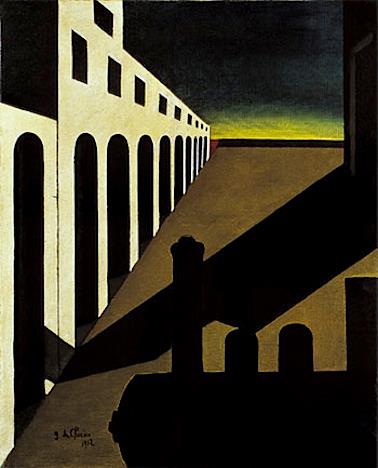
The Anguished Morning (de Chirico), Sonnet #361
Morning light steals darkness from its hiding places.
The unadorned plastered wall or triumphal arch
Outlines the visible by what it erases.
With each second the shadows go colder and parch.
After dawn the dark runs flat and dense from the square
Over vast lawns up the side of the cathedral.
A locomotive engine with its human bawl
Stops silently for a few hours, won’t be where
Decades ago before the wars the tracks were laid —
It wanders up the plaza like a drunken shade.
We don’t venture then into the shadows or sun.
A fool would let himself be caught by either one.
Morning light steals our souls from their hiding places,
Defining what we are by what it erases.
Thursday, July 20, 2017
Ship of Fools (Bosch), Sonnet #360
The ships of fools — hardly a pram —
A million in a small puddle
Full of people squealing, “I am!” —
A multitudinous muddle —
Even the largest has no rudder.
Beneath the overcrowded weight
The untarred bow plankings shudder —
When they burst there be men for bait.
Till then the riotous party,
Victorious, brave and hearty,
Gorges and drinks to their winning
Saint they love most when he’s sinning.
A busted lute leads them in song:
“Dam’ned they be, both right and wrong!”
Note: Click on the image to see a larger
version.
Thursday, July 13, 2017
Wood Interior (Emil Carlsen), Sonnet #359
I’ve no more memory for trees,
Can tell a maple from an oak
By the leaves, but the difference
Between others, only degrees
Of shape, height, branch, texture of bark,
I can’t think apart, only sense.
Even when I have learned the name,
I forget seeing similar,
All so alike, but not the same.
Trees are only familiar.
I walk in deep woods with my girls,
Marveling at mushrooms and burls
Growing from trunks (empty of words).
They know the names of trees and birds.
Thursday, July 6, 2017
The Satyr and the Traveler (Walter Crane), Sonnet #358
The goat man had always felt it unfair,
That he must clutch his bare chest in cold air.
The only thing worse was to look a fool
By wearing some dumb animal's wool.
He despised all humans, their sickly lust,
Their clothes and their suspicious trust of trust.
One winter's day he met a traveler,
Plump and well-clothed but for her sandled shins.
He decided to play the caviller,
And ridicule weakly man's meager sins.
The girl blew on her fingers in reply,
Then offered the satyr a steaming stew.
When she breathed on his bowl, he asked her, "Why?"
"To heat! To cool!" she cried, her lips the clue.
Thursday, June 29, 2017
Hadrian’s Villa (Peter Blume), Sonnet #357
The olive leans like an old man
Without his walking stick, its bole
Struck by a lightning bolt that ran
Into the ground and split its soul.
Its upper branches, though, are whole,
Heavy this time of year with fruit,
The offspring of sun, bark, and root.
One day a year we beat the tree,
Standing on long ladders with poles,
Knocking each ripened olive free
To fall and gather in blankets,
Lifted so every ovoid rolls
Into waiting wicker baskets.
For days we’ll feel rungs in our soles.
Thursday, June 22, 2017
A Street in Venice (John Singer Sargent), Sonnet #356
Some of our streets are so old they've started to breathe,
A soughing of softened mortar and slate crumbling,
A soliloquy like a bedside priest's mumbling,
And beneath the city runs its river Lethe.
The centuries of life don't pass unregarded,
Won't be left to the cemeteries' serried stones.
The blocks of brick buildings replace our blood and bones,
Once our loves and fears, our years, have been discarded.
They preserve our consciousness and our time
Aggregated with a stone mason's grasp of rhyme.
Still, brother and sister can stand in a doorway
For a moment and hear neither love nor regret
Except in the few secret words they have to say,
A sweetening of the air the streets won't forget.
Subscribe to:
Posts (Atom)