Thursday, February 3, 2022

Scars, Terzata #32

My body is richly scarred

As if caught in an avalanche.

It’s crisscrossed and barred —


Lines of sewn flesh branch,

Nose and brow bear hyphens,

Once pink areas, burned, blanch.


Time ravages us with its sins,

Which have nothing to do with will,

But the vulnerability of skins.


Not one baby’s molecule is still

In us after fifty years, discarded

Without changing us, until

We are perfect again, unmarred.  


Thursday, January 27, 2022

Eastern Europe, January, 1800, Terzata #31


The coming of the naked year

Is announced by desiccated corn,

Its leaves quivering with fear.


These fields will never be shorn,

New seeds never sown —

Nothing slouches to be born.


We have given all we own

To the bankers and the lords

And secured only blood by loan.


Our shacks are hollow gourds,

No water to drink, only beer.

There’s no strength in hordes.

Bawds lift their skirts and leer.


Note: Terzata is a term of my own invention, a conflation of "terza" as in"terza rima" and "sonata." Other than the varying number of feet per line, the difference from terza rima is that each Terzata ends with a quatrain whose second and fourth rhyme is the same as the poem's beginning rhyme, and is composed of 13 lines (terza rima can be of any length). The first 30 Terzata, written several years ago, can be found here:  30 Terzata


Thursday, January 20, 2022

My Human Disguise, Parts One and Two, Sonnets #599 and #600

With these two sonnets, this sequence of 600 ekphrastic sonnets, My Human Disguise, is complete.


My Human Disguise, Part One, Sonnet #599 


Dear friend, do not forget what is hidden

In both the interstices and behind

The ears and feet and fingers of the mind

Cannot ever be revealed unbidden. 

I’m not the human, this disguise you find.

You must call to something else inside me,

A me even I think a mystery.

Both of us stare into the mirror, blind.

Each image we see is pentimento,

The colors laid on increasingly thick,

But like aging time, erring, erratic,

An offering of Now as memento.

I don’t understand “my human disguise.”

I never have. Is it wisdom or lies?


My Human Disguise, Part Two, Sonnet #600


It’s time to put down “My Human Disguise.”

Take off the mask, erase the images.

Enough of playing tyrant with my eyes

To creations of painters and such sages.

At times these acts of synesthesia

Have restored the blank page’s amnesia.

Then I remember I’m not a being,

But only its disguise, a seen seeing . . . .

   “He draws aside the brocaded curtain

     As if to reveal an intimacy

     Tantamount to an indiscretion,

     Though it is just to allow us to see.”


Notes: 

1. The concluding quatrain is

from the beginning of Sonnet #1,

“The Art of Painting” (by Vermeer),

from “My Human Disguise.”


The Art of Painting


2. Since this is a blog, the sonnets are

presented in reverse order. The reader

can start here for the first four sonnets:


My Human Disguise Beginning Sonnets


Click here for the next seven sonnets:


Next Seven Sonnets


After that, click on "newer posts"

at the bottom of each page.


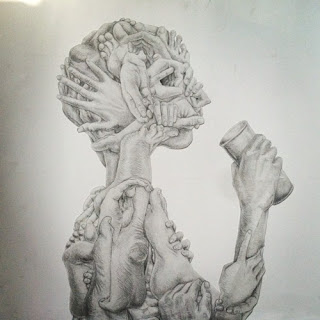
3. The drawing for these two

sonnets is by Alice Guerin, titled

“Hands and Feet,” and appears as

the cover of the book containing

the first 200 sonnets of “My Human

Disguise,” published by Voca Me Press

in 2016. It also appears with Sonnet #40.


Fort Wayne, 1/15/22

Thursday, January 13, 2022

Winter Landscape (Alexey Savrasov), Sonnet #598


1970

When the river that ran by my house froze

And the wind had blown the snow off the ice,

I would skate, chasing the schools of dark fish

(Careful not to run too close to the floes

A warm well cracked into sharp ice slices)

Until they’d leave the shallows and vanish.


1870

“That harshest of winters we all survived.

The wind (so murderous) kept us alive,

Piling snow wherever the cold sought in,

Even when we had an empty wood bin.”


“That winter whole families died, frozen —

In our district alone there were dozens.

We burned the houses — better used as graves —

The wind blew snow on our fields into waves.”


Thanks to Irina Velitskaya for recommending this painting.


My book of the first 200 of these sonnets is now available for purchase at Amazon. Click here:


Friday, December 31, 2021

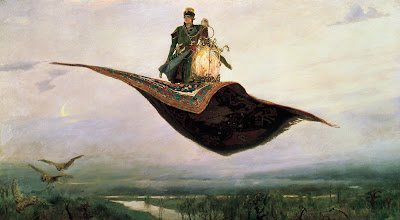
A Flying Carpet (Victor Tsarevitch), Sonnet #597


After 2021–A New Year’s Poem


“Flying carpet” had been more apt,

Fleeing, unreachable, rapt.

Not magical, but uncanny,

Not even real, epiphany

Without a point because it is

Not up to analysis.

We’re given only a number —

How many can’t be counted, known —

(Fraying threads, fabric unsewn).

“I’m certain that I remember,”

I say. The carpet flaps. I fall.

Can I recall one thing at all?

The memories that I most fear

Are those I hope to lose next year.


My book of the first 200 of these sonnets is now available for purchase at Amazon. Click here:

Sunday, December 26, 2021

Red Balloon (Paul Klee), Sonnet #596


We used to talk of divine afflatus,

Now no more— dubious inspiration

Led us to the corruption of desire,

Turning each individual to Us —

A collective of alienation

Satisfied with cold ashes and out fire.

I will instead take to my red balloon

And, rising above all that troubles me,

Seeking what only I call destiny

In the apposite hours, late and soon.

The cold wind, hidden sun, and burning gas,

Earth turning to images as I pass,

Undoes the fears and tremors my being

Held too dear, as seeking loves believing.


My book of the first 200 of these sonnets is now available for purchase at Amazon. Click here:


Thursday, December 23, 2021

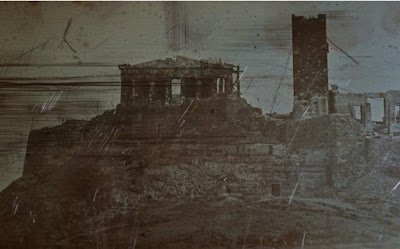
The Acropolis, 1842 ( Joseph-Philibert Girault de Prangey), Sonnet #595


The patina of time is thick.

We feel a life inside old brick

We don’t on a mountain’s summit

Or taste in a fall windstorm’s grit.

For millennia after it fell,

An Athenian couldn’t tell,

As he passed its ruins by,

If it was really there, or why.

It cried out to his soul, sundered

By countless years of surrender,

A mountain of crumbling stone

Better ignored and left alone.

Did he feel, see or comprehend

That glory has no casual end?


My book of the first 200 of these sonnets is now available for purchase at Amazon. Click here: