The sonnet sequence, "My Human Disguise," of 630 ekphrastic poems, was begun February 2011. It can be found beginning with the January 20, 2022 post and working backwards. Going forward are 20 poems called "Terzata," beginning on January 27, 2022. Fifty Terzata can be found among the links on the right. A new series of dramatic monologues follows on the blog roll, followed by a series of formal poems, each based on a single word.
Thursday, June 29, 2017
Hadrian’s Villa (Peter Blume), Sonnet #357
The olive leans like an old man
Without his walking stick, its bole
Struck by a lightning bolt that ran
Into the ground and split its soul.
Its upper branches, though, are whole,
Heavy this time of year with fruit,
The offspring of sun, bark, and root.
One day a year we beat the tree,
Standing on long ladders with poles,
Knocking each ripened olive free
To fall and gather in blankets,
Lifted so every ovoid rolls
Into waiting wicker baskets.
For days we’ll feel rungs in our soles.
Thursday, June 22, 2017
A Street in Venice (John Singer Sargent), Sonnet #356
Some of our streets are so old they've started to breathe,
A soughing of softened mortar and slate crumbling,
A soliloquy like a bedside priest's mumbling,
And beneath the city runs its river Lethe.
The centuries of life don't pass unregarded,
Won't be left to the cemeteries' serried stones.
The blocks of brick buildings replace our blood and bones,
Once our loves and fears, our years, have been discarded.
They preserve our consciousness and our time
Aggregated with a stone mason's grasp of rhyme.
Still, brother and sister can stand in a doorway
For a moment and hear neither love nor regret
Except in the few secret words they have to say,
A sweetening of the air the streets won't forget.
Thursday, June 15, 2017
Cave Painting, Sonnet #355
He didn't daub his walls with what he saw,
But what he thought he saw. The intervening
Eyes, which he rubbed till his eyelids were raw,
Lied to him, and made the seeing seeming.
The blank granite must have made him crazy,
Like seeing clear night skies devoid of stars.
He mudded a wall to make it hazy,
Only to find it dried and cracked with scars.
Why not purge his sight to cover the walls?
The staring eyes of his increasing brood,
Their ceaseless crying, then screeching for food,
Grew less loud there -- distant, near-silent calls.
His back to them, not telling them to hush,
He worked, erasing them with his paint brush.
Thursday, June 8, 2017
The Musicians's Brawl (Georges de la Tour), Sonnet #354
The sad oboist with his reeds and knife
Has gone blind looking at his faithless wife.
(The orchestra has other concerns: pay,
Benefits, selling tickets, and their say
In programming the least popular works.
They think the maestro's baton a dull dirk.)
The fighting began when the mad oboe,
Hearing mockery in the ostinato,
Blamed the clarinet for his cuckoldry.
The latter squeezed lemon juice in his eyes.
Mirable dictu! The oboe could see!
He embraced his colleague with grateful cries.
The harpist, his wife, slipped into the wings,
Where her dear concertmaster plucked her strings.
Thursday, June 1, 2017
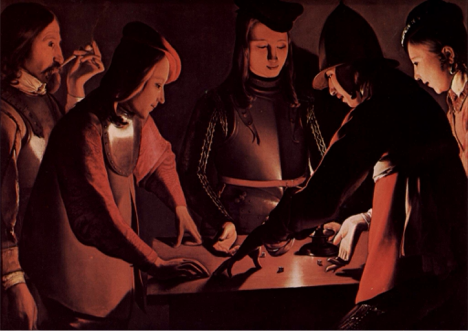
The Dice Players (Georges de la Tour), Sonnet #353
When it was over we played dice by candlelight.
The musty catafalque was empty once again.
We passed the last of the altar wine out quickly,
Like warm beer -- ate the wafers with a tender bite.
When someone gave a toast to Death, we said, "Amen."
"A shame!" we said, "Quick to still, he bypassed sickly!"
We played a game of our own invention called "Gone" --
An elimination game. Each threw a bone die
Three times and survived if even one was a one.
If all three were higher numbers your turn passed by.
The last one left had to "bury" the rest with pence,
Like the old Greeks' tradition -- one for each dead eye.
To lose was to win, which to us seemed perfect sense,
And glad tribute to His Lordship's evanescence.
Thursday, May 25, 2017
Medusa (Caravaggio), Sonnet #352
An old woman nodding off on the porch
Awoke when the dying moon rose, a torch
Of wan fire colder than a fractured bone
Plucked from a filthy stream. She'd been alone
For ninety years in a house full of pests
(Tucked in her lap some dessert for her guests);
Rat, spider, possum, silverfish, and snake
Crept in each night from the surrounding brake.
She combed serpents writhing out of her head
With the splayed fingers of the recent dead
Who'd come to have their way with her, young sports
Who with one look had turned to milky quartz.
A wind whispered and slipped beneath her jaw.
The crescent moon was the last thing she saw.
Thursday, May 18, 2017
Narcissus in Rome (Caravaggio), Sonnet # 351
Some men are just reflections of themselves.
What the mirror shows them is all they are.
As the head moves, the unblinking eye delves
Into itself with an unthinking stare.
I knew a man bent to kiss his image,
Stopping just short, careful not to smudge
The glass or ripple the pool of oil sludge.
He saw the epitome of his Age.
When others dared to look into his glass,
He wasn't, he was -- it was hard to tell.
When they saw him, they saw themselves as well.
One day his image caught fire; flaming gas
Consumed itself and left a dull halo,
His semblance struggling to form from below.
Note: I also write about this great image in
Sonnet #450.
Subscribe to:
Posts (Atom)